Custom fencing socks are a technical uniform component, not simply long athletic socks in club colors. They need to stay in position, work with fencing breeches and shoes, manage repeated training movement and remain comfortable across a full session or competition day.
For clubs, national programs, schools, academies, event organizers and fencing retailers, the product brief should connect uniform requirements with fit, construction, artwork and order planning. Competition rules vary by organization and event, so buyers should verify the current requirements that apply to their athletes before approving production.
Start With Coverage and Current Competition Rules
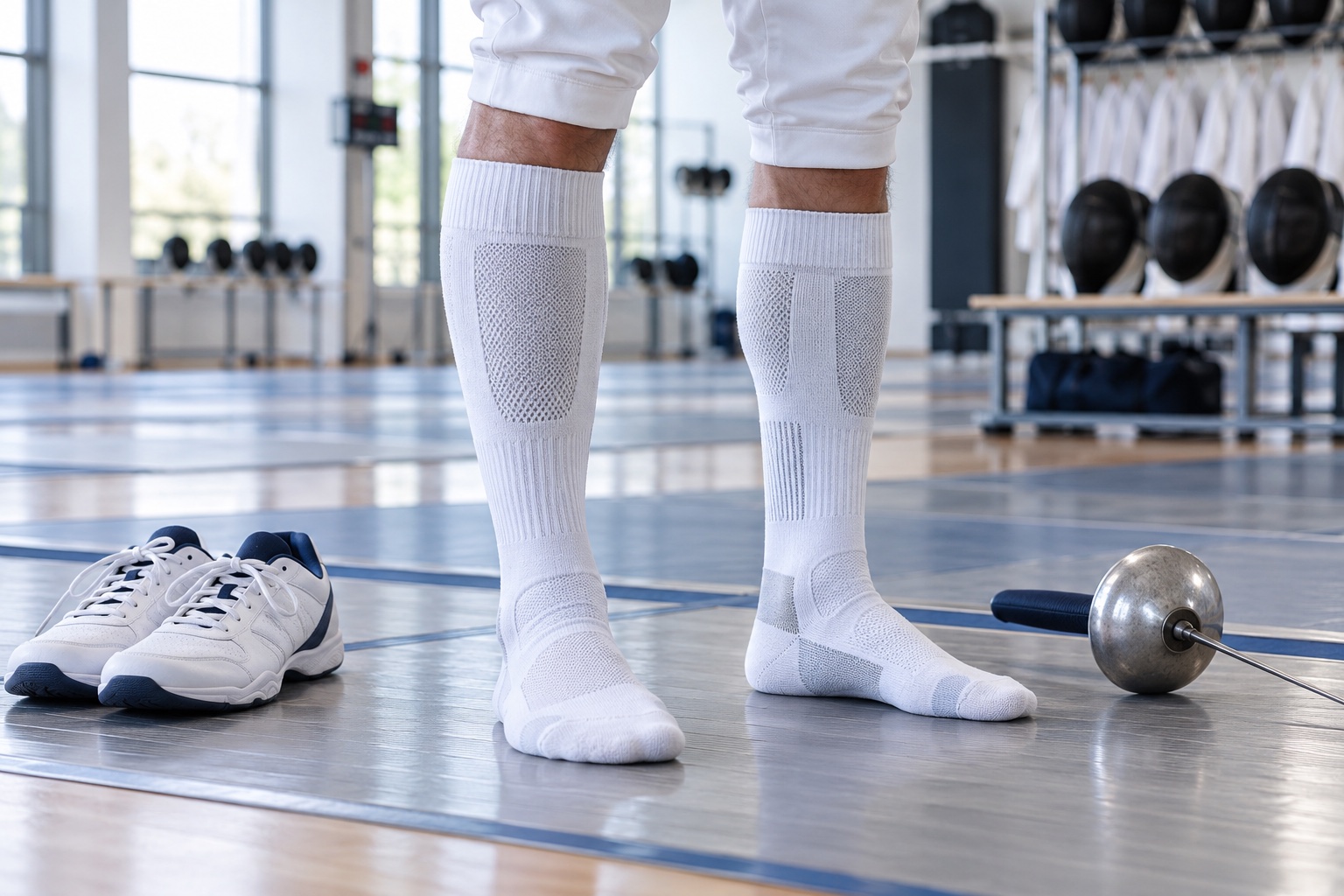
Long socks are commonly worn with fencing breeches so the lower leg remains covered. Current FIE material rules state that socks worn with breeches must cover the leg up to the breeches and be held up so they do not fall down. Domestic bodies or individual events may apply their own requirements, and rules can change.
Use the official FIE competition rules and the relevant national federation or event documents as the compliance reference. The manufacturer can build to an agreed length and construction, but the buyer is responsible for confirming the latest competition standard and any limitations on colors, logos or national-team marks.
Set the Correct Length and Stay-Up Cuff
A fencing sock should overlap appropriately with the breeches in the intended size. The specification should therefore include finished foot length, heel-to-cuff height, leg width and top opening rather than relying on “knee-high” as the only measurement.
The cuff needs enough recovery to remain up during lunges and repeated footwork without becoming a narrow pressure point. A broad ribbed cuff can distribute tension, while elastic through the leg can help control slippage and twisting. Test the sock with the actual breeches because the overlap and circumference affect the final fit.
Design the Foot for Fencing Shoes
Fencing shoes are relatively close fitting, so uncontrolled bulk can affect comfort. Use targeted cushioning instead of assuming that a fully thick sock is better. Light reinforcement at the heel, toe and high-friction side zones can improve durability while keeping the instep and forefoot flexible.
- Smooth toe-seam construction
- Secure heel pocket
- Targeted heel and forefoot cushion
- Reinforced toe and lateral wear areas
- Breathable instep or leg panels
- Arch-hold zone to reduce movement
Sample thickness should be assessed in the intended shoe rather than by hand alone.
Choose Durable, Moisture-Managing Yarns
Many fencing programs use polyester or nylon-rich blends for durability, shape retention, quick drying and repeatable color. Cotton can be included for hand feel, although the complete blend and construction should still manage moisture and recovery. Elastane supports fit through the foot, ankle and leg.
The yarn recipe should match the price position and laundering routine. Club training socks may prioritize easy care and repeated washing, while a premium competition or retail program may use finer yarns and more anatomical zoning. Ask for fiber composition, knit density and care instructions as part of the quotation.
Grade Youth and Adult Fencing Sizes
A single long sock rarely fits a complete academy. Foot length, heel position, leg height, calf width and cuff opening should be graded together. Youth sizes need shorter proportions; larger adult sizes need enough circumference without making the smaller sizes loose.
Provide the target shoe-size system and expected quantity by size. If the program serves mixed-gender or international teams, include the intended conversion chart on the packaging or order form. Fit samples at the smallest and largest planned sizes can reveal grading issues that a middle-size sample will not show.
Apply Team Colors, Logos and Identification Carefully
Custom fencing socks can use club colors, stripes, simplified knit-in marks and packaging that identifies team, weapon, size or athlete group. Jacquard artwork must remain readable when the leg is stretched. Keep logos away from high-distortion or high-abrasion areas unless the sample proves the placement works.
Competition uniforms may restrict certain marks or color treatments. Confirm current event rules before production, especially for national-team identity, sponsor logos or international competition. For training, merchandise and supporter ranges, the artwork direction may be more flexible. The logo placement guide explains how stretch changes knitted artwork.
Approve Fit Through Real Fencing Movement
Test the sample with breeches and fencing shoes during warm-up, advances, retreats and lunges. The sock should stay aligned without sliding down, rotating under the foot or bunching behind the knee. After wear, inspect the heel, toe, lateral foot, cuff and artwork for stress.
- Required overlap with the breeches
- Cuff hold through repeated movement
- No uncomfortable folds in the shoe
- Heel remains correctly positioned
- Toe seam and internal floats feel smooth
- Pair length, artwork and color remain consistent
- Wash recovery follows the agreed test
Record results using the sample approval checklist before confirming bulk production.
Prepare a Quote-Ready Fencing Sock Brief
Send the manufacturer the intended market, competition or training use, required coverage, finished measurements, size breakdown, colors, artwork, material direction, quantity and packaging. State whether the socks are part of a club kit, school uniform, event pack, federation program or private-label retail collection.
Packaging can include a paper band, labeled poly bag, pouch or team-set format. Confirm size conversion, fiber content, care, origin information, SKU or barcode needs and carton packing. MOQ depends on construction, color, artwork and size allocation. Review the broader custom sock options and custom sock MOQ guide before asking for a final quotation.
Frequently Asked Questions
How long should fencing socks be?
They should provide the coverage required by the relevant rules and overlap properly with the intended breeches. Final height must be graded across youth and adult sizes.
Can fencing socks use club colors and logos?
Yes for many team, training and retail programs, but the buyer should verify the current rules for the specific competition, federation and athlete category before approving artwork.
Should fencing socks be heavily cushioned?
Not necessarily. Targeted cushioning and reinforcement can support comfort and durability without creating excessive bulk inside close-fitting fencing shoes.
What should be checked on a fencing-sock sample?
Check breeches overlap, cuff hold, foot and heel fit, shoe comfort, internal seams, artwork stretch, pair consistency and recovery after the agreed wear and wash review.