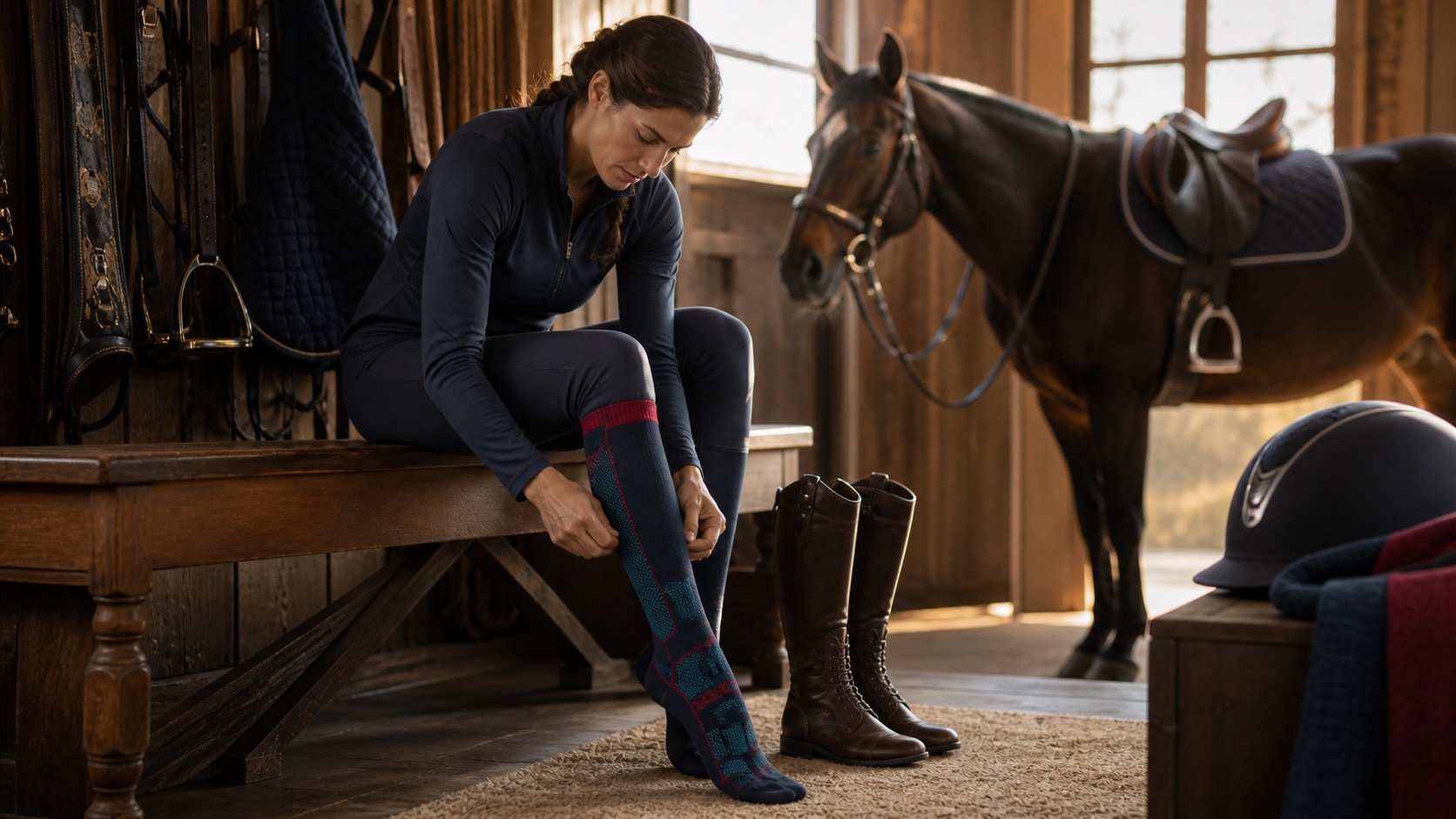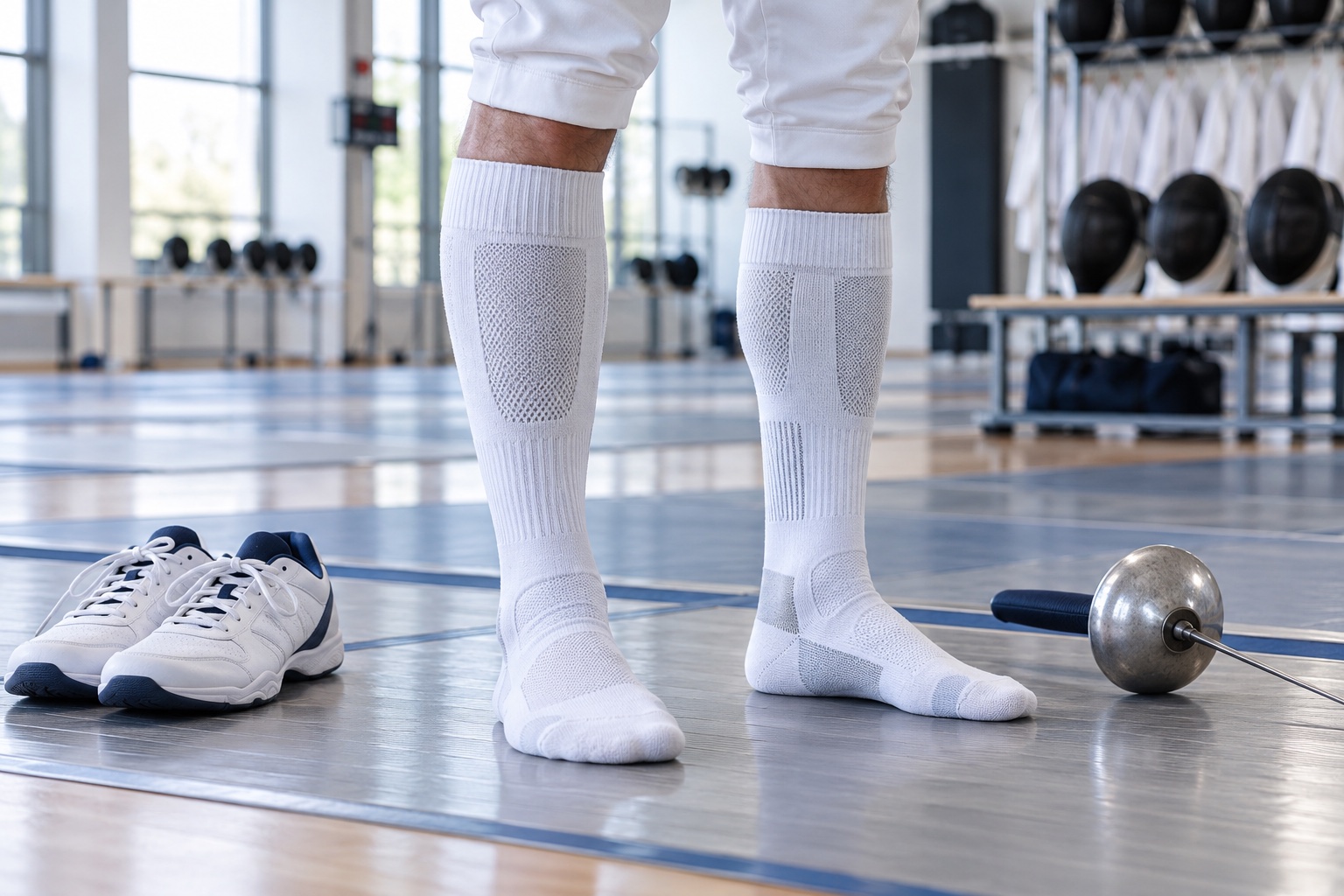
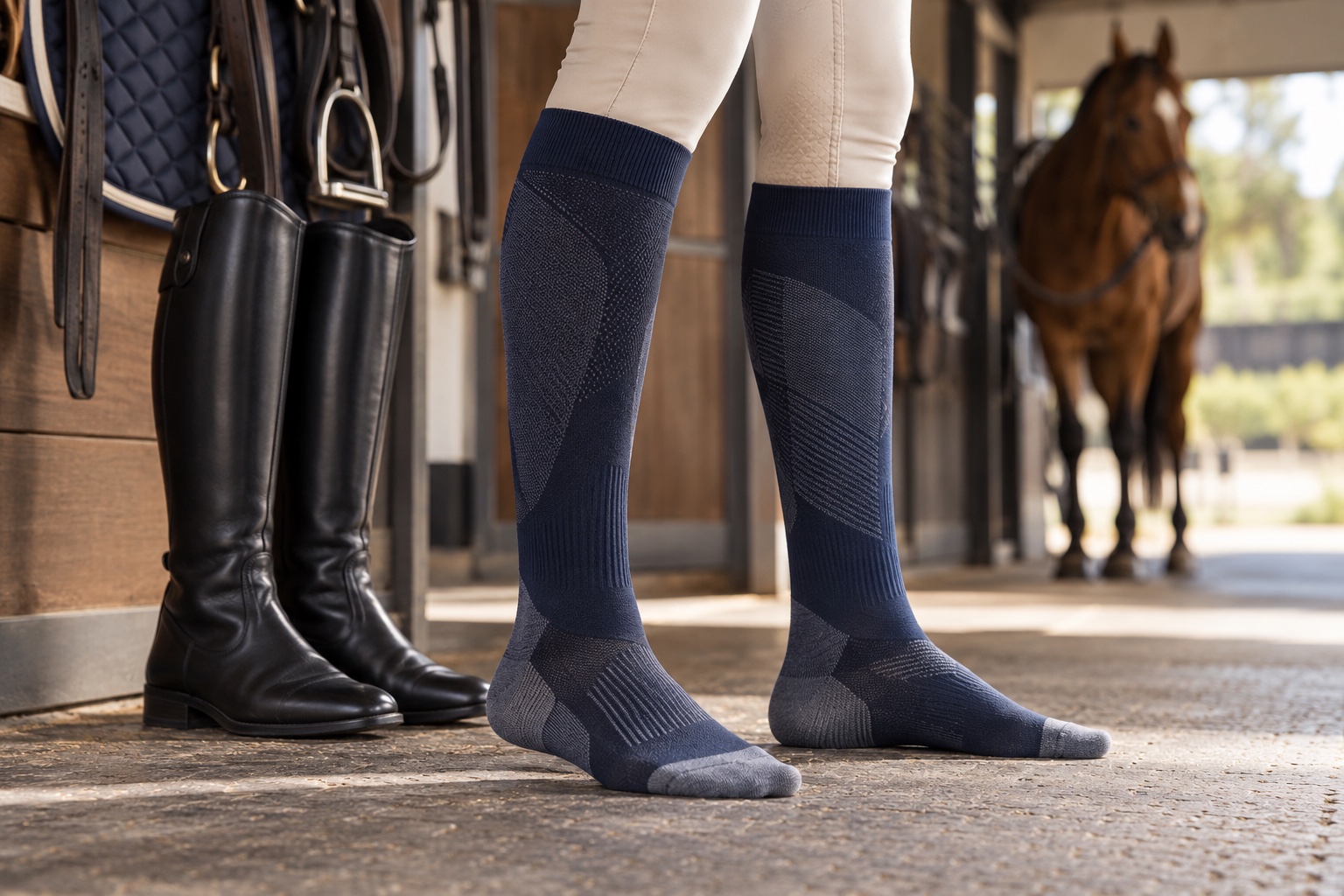
Custom equestrian riding socks need to work as part of the rider's complete boot system. A sock that feels comfortable in casual footwear can become too bulky, slip down or create pressure when worn inside a fitted tall boot. For an equestrian brand, tack shop, riding club or event program, the product brief should therefore begin with the discipline, footwear and wearer rather than with artwork alone.
This B2B guide explains the main decisions behind a private-label riding sock: height, leg construction, foot cushioning, yarn, sizing, branding, sampling and packaging.
Define the Riding Use Case Before Choosing the Sock
Start by identifying where and how the sock will be worn. A competition-focused tall-boot sock may need an especially thin, smooth leg. A stable-work or country-riding program may need more warmth, cushioning and abrasion resistance. A children's riding range needs its own proportions rather than a reduced adult label.
- English riding, dressage, show jumping or eventing
- Tall boots, paddock boots or casual stable footwear
- Competition, training, daily yard work or retail gifting
- Warm-weather, all-season or winter use
- Adult, youth or mixed family size assortment
A clear use case helps the manufacturer decide how much thickness belongs in the leg, footbed and heel. It also keeps decorative details from interfering with boot fit.
Build a Low-Bulk Leg for Tall Riding Boots
The upper leg of a riding sock often needs to be thinner than the foot. A fine-gauge knit can reduce bunching behind the knee and excess pressure around the calf while still providing coverage between skin and boot lining. The cuff should remain secure without forming a narrow, harsh band.
Ask the manufacturer to review leg width, calf grading, overall height and stretch recovery. Decorative jacquard patterns can be used, but large floats, heavy embroidery or thick rib structures may be uncomfortable inside a closely fitted boot. If a logo is required on the leg, confirm its position while the sock is worn and stretched.
Engineer the Foot for Comfort and Durability
The foot can use a different construction from the boot leg. Many programs combine a smooth, low-bulk shaft with reinforcement or light cushioning through the heel, sole and toe. The goal is to improve comfort and wear life without occupying too much space inside the boot.
- Smooth or linked toe-seam direction
- Reinforced heel and toe yarn
- Light terry under the heel and forefoot
- Breathable instep panel
- Secure heel pocket and arch-hold zone
- Controlled interior floats and trimmed yarn ends
Test the sample with the intended boot. A thicker footbed may feel pleasant by hand but become restrictive in performance footwear.
Select Yarn for Climate, Care and Price
Material should match the season, care expectation and commercial position. Nylon and polyester blends can support a fine, durable leg with repeatable color. Cotton-rich blends provide a familiar hand feel for everyday retail programs. Merino wool blends can suit premium and cold-weather ranges when wool content, care and price are carefully specified.
Do not evaluate the fiber name alone. Yarn count, knit density, ventilation, reinforcement and elastane placement all affect fit and durability. For a broader material comparison, use the sock yarn and construction guide.
Grade Sizes for Riders, Calves and Boots
A practical riding-sock size chart should connect shoe size with foot length while also controlling leg height and calf width. Youth sizes need a shorter foot and leg, not only a smaller cuff. Adult assortments may need separate unisex, women's, men's or wide-calf directions depending on the target customer.
Provide the destination market and expected size distribution before requesting a quotation. During sampling, check heel position, toe room, cuff height and whether the sock stays smooth after the boot is put on and removed. One sample size does not prove the complete grading plan.
Plan Stable, Club and Retail Branding
Custom equestrian socks can carry stable colors, club stripes, horse or rider motifs, sponsor marks and retail-brand artwork. Jacquard knitting works well for repeat patterns and simplified logos. Embroidery may suit a small outer-calf mark when the boot fit allows it. Printed packaging can carry more detailed identity without adding bulk to the sock.
Keep the design visible at the intended wearing point. A motif hidden under the boot may still help retail presentation, while a cuff detail can remain visible above some boots. Review the custom sock logo placement guide before finalizing artwork size and orientation.
Approve the Sample in Real Riding Footwear
Approve more than color and logo. Wear the sample with the intended breeches and boots, then check the sock after walking, riding-position movement and boot removal. Record the sample version and every required correction before bulk production.
- Leg remains smooth without twisting or bunching
- Cuff stays up without uncomfortable pressure
- Heel pocket stays in position
- Toe seam remains comfortable inside the boot
- Reinforcement and cushioning align with wear zones
- Artwork remains clear at realistic stretch
- Measurements recover after wear and an agreed wash check
Use the full custom sock sample approval checklist to document the production standard.
Prepare a Quote-Ready Equestrian Sock Brief
Send the manufacturer the sock height, intended riding use, footwear, material direction, size range, colorways, artwork, estimated quantity and packaging requirements. Clarify whether the program is for a stable, team, tack shop, equestrian event or private-label retail collection.
Packaging options can include a paper band, hang card, pouch, gift box or coordinated multipack. Confirm fiber, care, size and origin information for the destination market. MOQ should be reviewed per design, color and size assortment rather than treated as one universal number. Explore the existing custom equestrian socks program or compare all custom sock options before requesting a sample.
Frequently Asked Questions
How tall should equestrian riding socks be?
They should suit the intended boot and wearer. Tall-boot programs commonly use a knee-high or over-the-calf direction, with final height graded for youth and adult sizes.
Can the leg and foot use different constructions?
Yes. A thin, smooth leg can be combined with a reinforced or lightly cushioned foot. This is a common way to balance boot fit, comfort and durability.
Can stable logos and horse patterns be knitted into the sock?
Yes. Simplified artwork can be developed in jacquard, while detailed brand information can also be carried on private-label packaging. Artwork must be reviewed at the actual knit scale.
What should be tested on the riding-sock sample?
Check fit in the intended boot, cuff hold, heel position, toe comfort, internal construction, artwork stretch, wash recovery and the packed presentation.