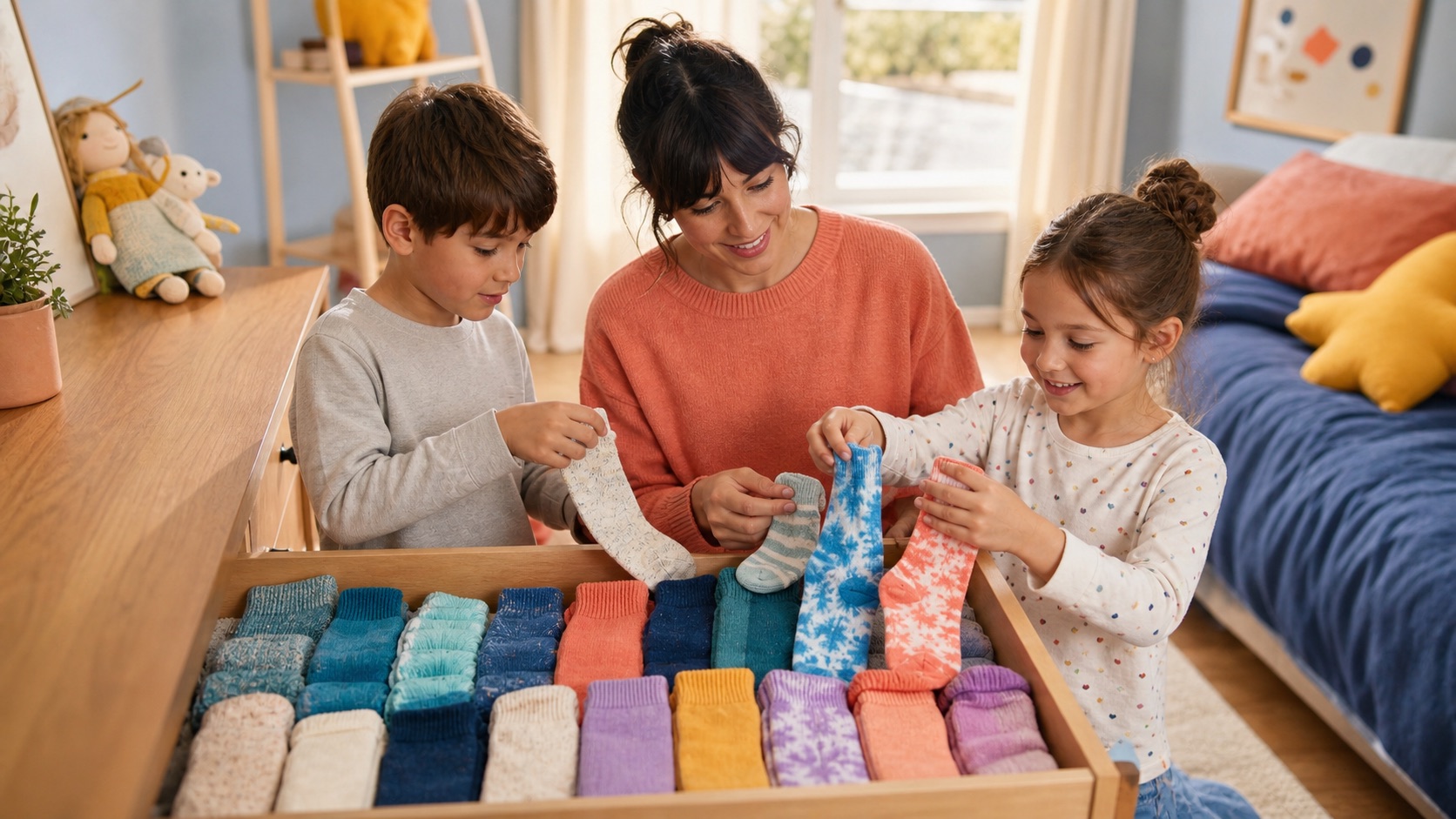
Children's sock sizes can be confusing because labels may use age, shoe size or broad categories such as toddler, little kid and big kid. Age is only an estimate; measuring the foot and checking the maker's chart gives a more reliable starting point.
A good children's sock stays smooth, keeps the heel in place and leaves the toes free to move. Here is how to choose and check the fit.
Measure Both Feet
Have the child stand naturally on a sheet of paper while wearing no socks. Mark the back of the heel and the end of the longest toe, then measure the distance. Repeat for both feet and use the larger measurement.
Follow the brand's instructions, since some charts use foot length while others use shoe size. Do not add arbitrary “growth room” unless the chart tells you to; the size range already accounts for stretch in many designs.
Why Age-Based Sizing Is Limited
Children of the same age can have different foot lengths and widths. Age labels are convenient for gifts, but they are less precise than measurements. If a package shows both age and shoe size, prioritize the size that reflects the child's current foot.
Infant, toddler, children's and youth shoe numbering can also overlap across countries. Confirm whether the chart uses US, UK or EU sizes.
Check the Heel and Toe
Put the sock on before the shoe and check:
- The heel pocket sits around the heel rather than under the arch.
- The toe seam lies flat and does not pull against the toes.
- There are no wrinkles beneath the foot.
- The child can wiggle the toes naturally.
- The design does not become extremely distorted when stretched.
Ask the child how it feels, but also inspect the fit directly. Younger children may not identify pressure clearly.
Look at the Cuff
The cuff should stay up without leaving a painful or very deep mark. A wide ribbed cuff distributes tension better than a narrow band in many styles. For wider calves, choose an appropriate construction instead of a foot section that is too long.
If the sock repeatedly falls down, it may be too large, stretched out or poorly matched to the leg—not simply “comfortable.” Loose fabric can bunch inside shoes.
Choose Materials by Activity
Cotton blends are versatile for school and casual wear. Synthetic sports blends can dry efficiently for practice. Wool blends offer temperature versatility for hiking and winter. Grip socks may be useful indoors, but the tread must stay under the foot and no sock can guarantee against slips.
Match thickness to the shoe. Thick socks in fitted school shoes can crowd growing toes.
Safety and Construction Checks
Inspect children's socks for loose threads inside the toe, unsecured decorations and damaged grip elements. For babies and toddlers, follow local product-safety rules and keep detachable trims away from products where they could become a hazard.
Product age grading, flammability, labeling and chemical requirements vary by market. Retailers and importers should verify the rules for every destination.
When to Size Up
Consider the next size when the heel consistently sits below the heel, the toes are pulled tight, the sock leaves pressure marks despite correct positioning or the measured foot exceeds the chart. Do not wait for holes at the toe to be the first sign.
Re-measure regularly during growth periods and after changing shoe sizes.
Frequently Asked Questions
Should kids' socks have room to grow?
They should fit now. Excess length can wrinkle and rub. Use the product's size range and move up when measurements reach the limit.
Why do children's socks shrink?
Cotton content, heat and washing can affect dimensions. Follow the care label and avoid excessive dryer heat.
Are seamless socks better for children?
A smooth toe can be more comfortable for children sensitive to ridges. “Seamless” constructions vary, so inspect the inside and test the fit.
Explore our kids' sock collection by size, height, material and activity.