Custom printed socks can carry photographs, illustrations, gradients and repeating patterns that would be difficult to knit. The quality of the result depends on choosing the right print process, designing for a three-dimensional stretchy product and approving more than a flat digital mockup.
This guide helps brands, event organizers and retailers prepare a clearer printed sock order.
Start With the Intended Use
Define whether the socks are for retail, corporate gifts, a sports event, a wedding, merchandise or a one-time promotion. The use affects material, cushioning, packaging, minimum quantity and durability requirements.
Also decide which part of the sock should carry artwork. An all-over pattern, ankle logo and photo panel each create different production constraints.
Common Printing Methods
Dye sublimation uses heat to transfer dye into compatible synthetic fibers. It can reproduce complex, full-color artwork and works well for all-over designs. The base material and construction must be suitable for the process.
Direct-to-garment or digital textile printing applies artwork to the sock or textile surface. Capability varies by machine, ink and fiber. Ask about wash durability, color range and how the image behaves when stretched.
Screen printing can suit simpler graphics and limited colors, depending on the sock and print area. It may create a different hand feel from dye-based methods.
Knitted-in graphics are an alternative, not a print method. They work well for simplified logos and patterns but use the resolution of the knit rather than photographic detail.
Design for Stretch
A sock is curved when worn and contracts when off the foot. Fine lines, faces and text can distort across the ankle or heel. Keep important details away from the strongest stretch zones and avoid placing small text across seams or folds.
For a repeating pattern:
- Use a tile that joins cleanly.
- Leave breathing room between motifs.
- Test the scale at actual sock size.
- Check how the pattern meets at the front and back.
- Decide whether every pair needs identical placement.
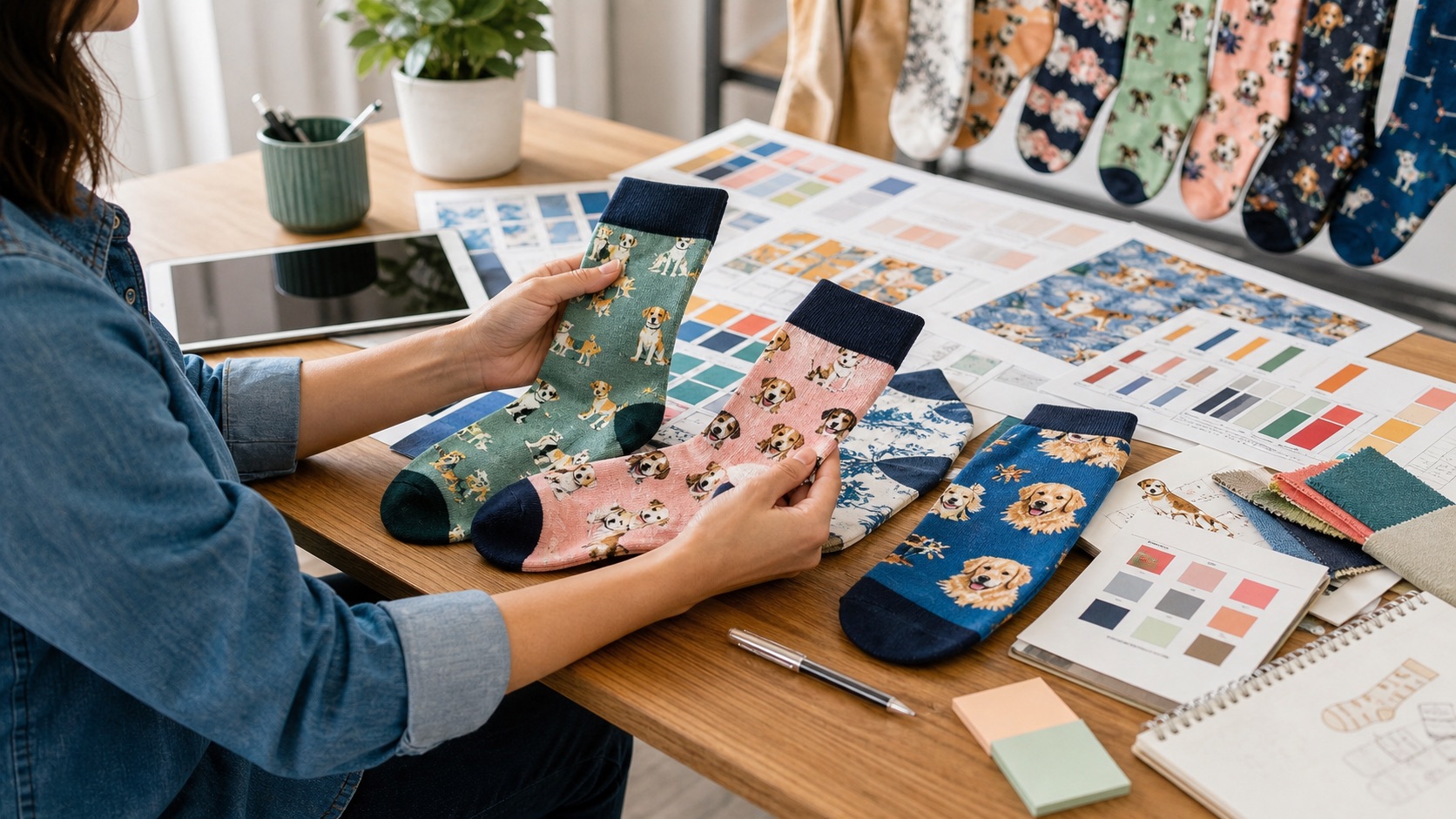
For photo socks, provide a high-resolution image with the subject clearly separated from the background. A designer may need to crop or simplify it.
Prepare Artwork Correctly
Ask the supplier for a template and file requirements before designing. Common requests include vector files for logos and high-resolution raster files for photographs. Provide named color references, but expect some difference between backlit screens and printed textile.
Do not submit artwork you do not have the right to reproduce. Brands, team marks, characters and photographs may require permission from their owners or subjects.
Approve a Physical Sample
A digital mockup confirms placement, not final color, fit or fabric behavior. If the project matters to a launch or brand program, review a physical sample for:
- Image clarity at rest and when worn
- White gaps that appear under stretch
- Color accuracy and consistency
- Seam alignment
- Toe and heel comfort
- Print feel against the skin
- Wash appearance
Photograph the approved sample and keep one as a production reference.
Confirm Sizes, Quantity and Packaging
Use the target audience's real shoe-size distribution. A “one-size” sock still has practical limits, and artwork can look different across graded sizes. Confirm whether the design is re-scaled or cropped.
Your written order should list quantity by size, design and packaging type. Add barcode, fiber label, country-of-origin, warning and language requirements before production—not after the socks are complete.
Questions for a Printed Sock Supplier
- Which print process will be used and why?
- Which fibers and sock constructions are compatible?
- What is the printable area?
- How does the design change when stretched?
- What are the minimum quantity and lead time?
- Can I approve a physical sample?
- What wash and colorfastness tests are available?
- Who checks artwork rights and labeling requirements?
Frequently Asked Questions
Can any image be printed on socks?
Technical capability and legal permission both matter. Detailed images may need editing, and you must have the right to use the artwork.
Are printed socks durable?
Durability varies by print process, fiber, use and care. Request relevant test information and follow the care label.
Is printing better than knitting a logo?
Printing suits detailed, multicolor artwork; knitting suits simplified graphics integrated into the sock. The design and desired feel determine the better method.
Explore our custom printed sock program and prepare your artwork, size breakdown and delivery target for a quote.